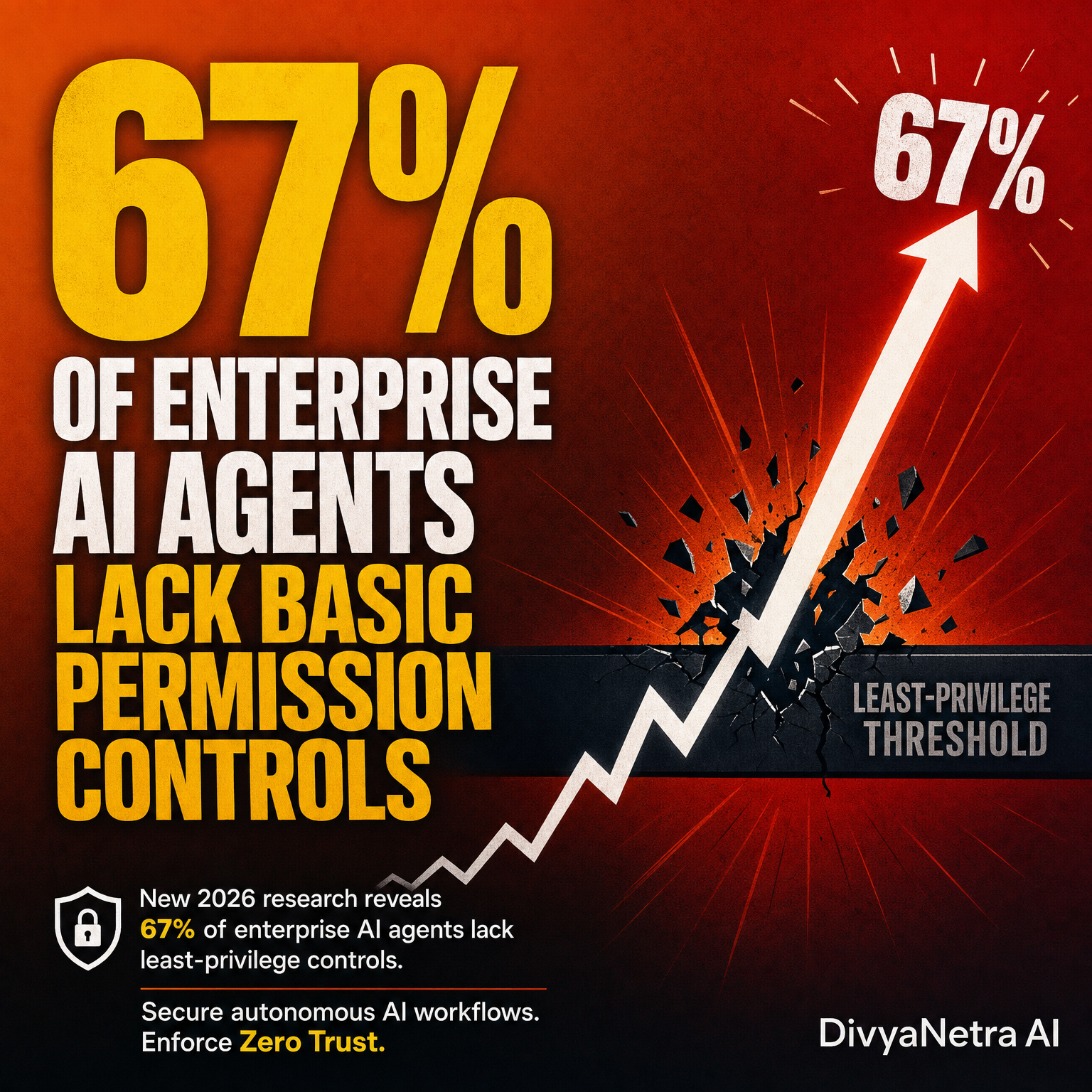
67% of Enterprise AI Agents Lack Basic Permission Controls
67% of Enterprise AI Agents Lack Basic Permission Controls
Introduction
Enterprise enthusiasm for autonomous AI agents has reached an all-time high, but a alarming governance gap threatens to undermine this momentum. According to research released by Cequence and Enterprise Management Associates (EMA) on August 31, 2026, 94% of enterprise security leaders express high confidence in their AI agents, yet 67% fail to enforce basic least-privilege controls.
This massive disconnect highlights a critical vulnerability in modern IT infrastructure. While business leaders rush to deploy agentic workflows across customer support, software engineering, and supply chain management, security teams are struggling to keep pace. Autonomous agents are routinely granted broad database access, long-lived API tokens, and administrative roles without strict execution boundaries.
For enterprise decision-makers, this security blind spot represents an urgent operational risk. When AI agents execute code, call external endpoints, and process sensitive internal data without granular access controls, the risk of data exfiltration and unauthorized systemic actions skyrockets. Industry reporting highlights that enterprises say their AI agents are secure; the data say otherwise, exposing severe vulnerabilities across corporate networks.
Why AI Agent Permission Controls Are Failing in Enterprise Environments
The root cause of this vulnerability lies in how organizations port legacy identity and access management (IAM) models over to autonomous non-human identities. Traditional enterprise security relies on predictable human interactions or deterministic microservices. In contrast, agentic AI operates nondeterministically—dynamically choosing which APIs to call, which parameters to supply, and which reasoning paths to pursue based on user input.
When security teams integrate AI agents, they frequently assign them broad enterprise service accounts to minimize operational friction. Consequently, a single agent tasked with summarizing customer tickets might hold full write access to the underlying CRM database or cloud storage buckets. Recent industry benchmark surveys show that 65% of enterprises have seen AI agents act out of scope, leading to unintended data modifications and security incidents.
Standard security controls are ill-equipped to govern these dynamic workflows. Simply restricting data access at the database tier is insufficient when the agent itself holds execution authority over business logic. Building resilient architectures requires moving from traditional perimeter controls toward comprehensive frameworks, as outlined in our guide on Data Governance vs Decision Governance for AI Execution.
The Dynamic Execution Trap
Unlike static scripts, autonomous agents formulate execution plans at runtime. Common failure modes include:
- Over-Privileged API Keys: Agents using global organizational keys rather than scoped, short-lived tokens.
- Unrestricted Tool Calling: AI models capable of invoking system commands or external endpoints without explicit human confirmation.
- Cascading Context Contamination: Indirect prompt injection forcing agents to abuse inherited credentials to access restricted networks.
Moving Beyond Legacy IAM: Implementing Zero Trust for AI Agents
Addressing the 67% security deficit requires fundamentally rethinking how non-human identities interact with corporate infrastructure. Leading security researchers emphasize that identity and permissions aren't enough to govern AI agent behavior. Enterprise identity systems must evolve from static role-based access control (RBAC) to dynamic context-aware authorization policies.
Enforcing enterprise AI agent security demands a dedicated Zero Trust architecture designed specifically for non-deterministic agents. Every action an agent takes—whether querying an internal SQL server or sending an external payload—must be authenticated, authorized, and validated in real time. Organizations cannot assume an agent's request is benign simply because it originates from an internal microservice.
Furthermore, integrating AI without adjusting underlying enterprise processes leads directly to compounding operational risks. As explained in our analysis of why unchanged workflows accelerate AI errors, embedding autonomous models into fragile legacy systems amplifies systemic errors across the organization.
5 Steps to Enforce Enterprise AI Agent Security
To bridge the gap between AI confidence and actual security readiness, security leaders should immediately institute these five operational strategies:
- Implement Scoped, Ephemeral API Tokens: Never issue long-lived service account keys to AI agents. Utilize token-exchange services that grant context-specific, short-lived tokens valid only for the duration of a single task.
- Enforce Least-Privilege Function Schemas: Strictly restrict tool calls in model system prompts and client SDKs. Ensure agents only possess access to the specific database fields required to fulfill explicit user requests.
- Deploy Real-Time Behavioral Guardrails: Establish an intermediary inspection proxy between the AI agent and enterprise APIs to block out-of-scope executions and anomalous query patterns.
- Isolate Agentic Workflows in Secure Enclaves: Run execution environments inside isolated containers with outbound network filtering to prevent unauthorized lateral movement across enterprise networks.
- Establish Comprehensive Action Auditing: Maintain immutable telemetry logs tracking agent reasoning paths, function calls, API payloads, and response signatures for real-time compliance monitoring.
Conclusion
The latest August 2026 data serves as a stark wake-up call for modern enterprise leaders. While 94% of organizations trust their autonomous models, the fact that 67% lack basic least-privilege controls exposes enterprise networks to severe operational and security threats. Trusting an AI agent without establishing rigorous permission boundaries is an unsustainable business risk.
Achieving true enterprise AI agent security requires moving beyond passive access policies toward active runtime decision governance. By treating AI agents as untrusted entities that require dynamic authorization at every step, organizations can safely capture the speed and intelligence of agentic automation.
At DivyaNetra AI, we help enterprise organizations build robust governance, security, and architectural guardrails around complex autonomous systems. Protect your enterprise infrastructure while scaling intelligent workflows by partnering with our AI security experts today.