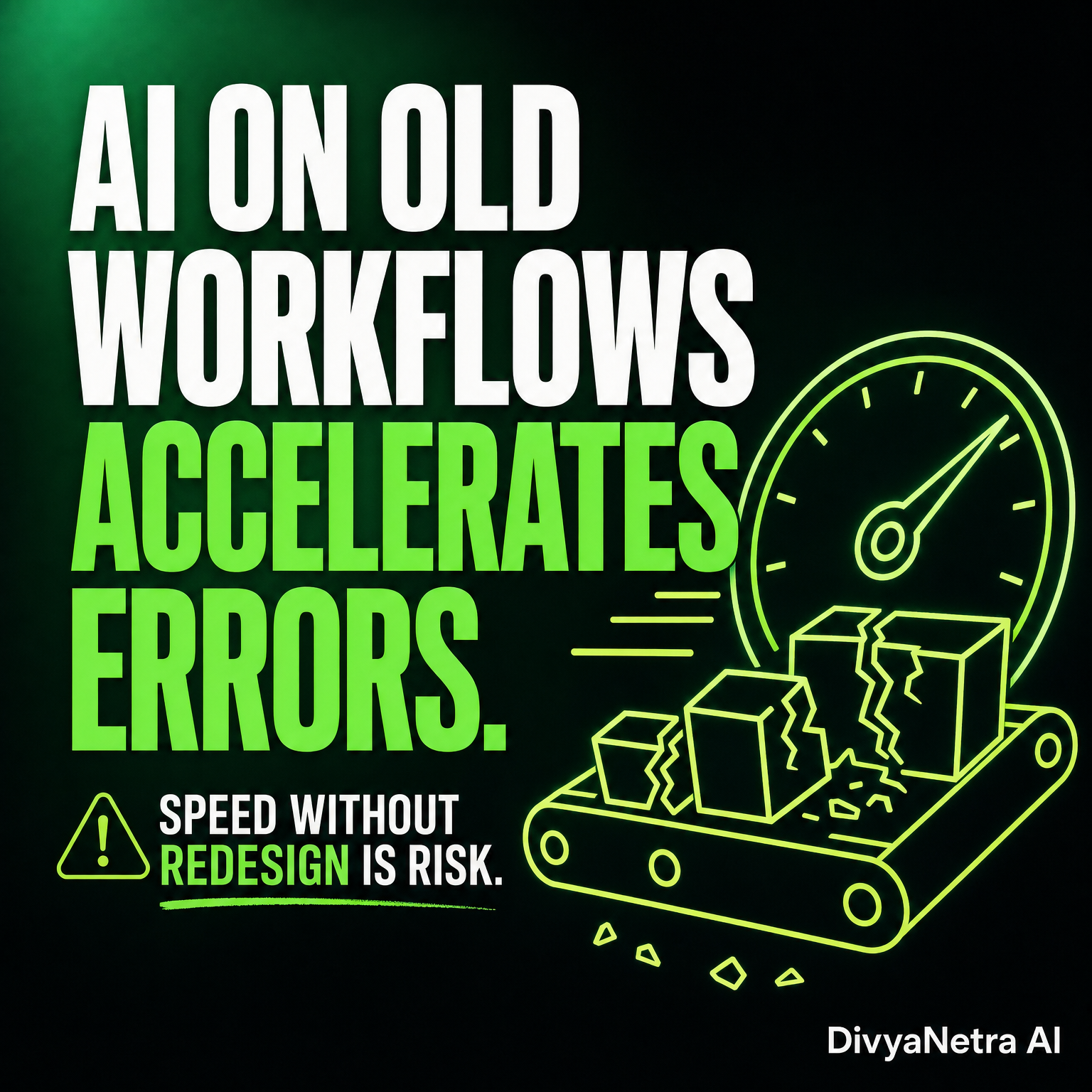
Why Unchanged Workflows Accelerate AI Errors | DivyaNetra AI
Why Adding AI to Unchanged Workflows Just Accelerates Errors
Introduction
On August 11, 2026, Forbes reported a stark warning from Canva’s former CFO: business leaders who adopt generative AI and automation tools without redesigning their underlying operational workflows do not just waste capital—they risk accelerating mistakes at scale.
When executives bolt state-of-the-art models onto broken, manual, or fragmented systems, the speed of technology becomes a double-edged sword. Instead of achieving operational efficiency, organizations multiply output errors, compromise data integrity, and create severe compliance vulnerabilities.
Understanding why this breakdown occurs is critical for modern enterprises. As organizations race to maintain competitive advantage, success depends not on how fast technology is deployed, but on how effectively foundational processes are restructured.
Why AI Workflow Redesign Must Precede Automation
Deploying advanced algorithms without restructuring operations creates what experts call a operational multiplier effect. When a bad manual process takes three days, an enterprise makes a handful of administrative errors. When that exact same process is automated to run in three seconds, the system generates thousands of incorrect outputs before humans even detect the drift.
Leading industry analysts emphasize that leaders must don't automate bad workflows: why AI should begin with redesign if they expect measurable ROI. Traditional workflows rely on human intuition to catch edge cases, missing metadata, and procedural gaps. Automated systems, by contrast, execute instructions literally, turning minor process ambiguities into enterprise-wide operational failures.
The Velocity Trap of Legacy Processes
Legacy operations were designed around human speed, multi-tier approvals, and physical handoffs. When businesses plug autonomous agents into these outdated frameworks, bottleneck dynamics shift rapidly.
- Data silos pollute model contexts: Disconnected databases supply conflicting facts to inference engines.
- Approval loops stall execution: Rapid AI outputs pile up behind slow manual verification checkpoints.
- Error cascade accelerates: Flawed upstream assumptions propagate instantly to downstream reporting and customer touchpoints.
To build resilient operations, enterprises must move beyond simple task automation and focus on foundational restructuring. Unified data for business: guide to smarter decisions provides the necessary structural clarity that allows AI tools to process accurate information across teams.
How Unchanged Workflows Scale Mistakes in Enterprise AI Adoption
Many decision-makers still fall victim to common misunderstandings about what modern software actually solves. A research insight on what leaders still get wrong about AI reveals that treating artificial intelligence as a simple plug-and-play productivity patch consistently fails to deliver expected enterprise value.
As enterprise AI agents tripled across global deployments, the gap between organizations with modern workflows and those with legacy operations widened. Organizations attempting to automate outdated frameworks experience specific operational failure modes:
- Hallucination Magnification: Automated pipelines feed synthetic outputs directly into enterprise databases without structured verification checks.
- Compliance Drift: Outdated auditing processes fail to log autonomous actions, creating silent regulatory violations.
- Customer Friction: Automated customer workflows deliver confidently incorrect answers at scale, damaging brand trust.
When business logic is modernized first, modern systems excel. As detailed in our guide on how AI executes business strategies: from analysis to action, autonomous tools require structured operational pathways to convert high-level objectives into reliable business outcomes.
5 Practical Steps to Prevent AI Implementation Mistakes
To avoid accelerating operational errors, enterprise leaders should follow a structured blueprint for workflow transformation before rolling out intelligent automation.
- Map end-to-end data dependencies: Identify every database, document repository, and manual handoff involved in the target business process.
- Eliminate redundant human checkpoints: Redesign approval flows so human oversight is strategically focused on high-risk exceptions rather than routine processing.
- Establish continuous evaluation metrics: Track accuracy, latency, and system drift in real time to catch operational anomalies early.
- Conduct robust security testing: Perform rigorous evaluations using AI agent security testing: pre-deployment guide methodologies before releasing agents into live production environments.
- Redefine job roles alongside automation: Realign team responsibilities, following insights on how AI is reshaping workflows and redefining jobs to ensure employees manage automated outcomes effectively.
Conclusion
Accelerating bad processes with fast technology only produces bad results faster. The warning from financial and tech leaders is clear: adding advanced automation to unchanged legacy operations inevitably magnifies errors across the enterprise.
Achieving sustainable return on investment requires a proactive commitment to thorough AI workflow redesign. Organizations that take time to audit data flows, rethink approval structures, and establish continuous security boundaries build scalable, resilient platforms for long-term growth.
DivyaNetra AI helps enterprise organizations audit, optimize, and safely scale autonomous systems. Modernize your underlying business architecture today to ensure your technology investments deliver speed, precision, and measurable value.