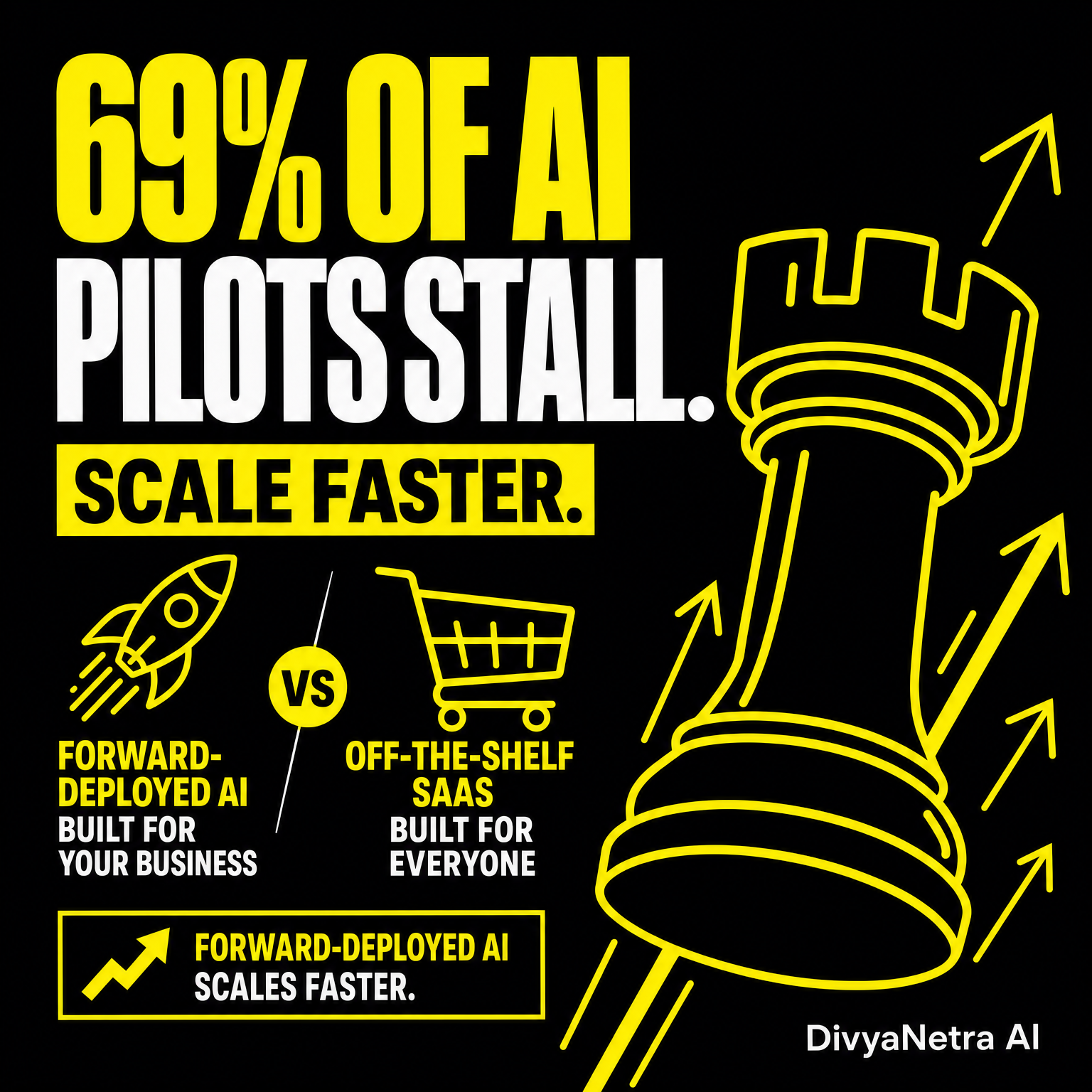
Forward-Deployed AI vs Off-the-Shelf SaaS: Scaling Guide
Forward-Deployed AI vs Off-the-Shelf SaaS: Which Scales Faster?
Introduction
The enterprise AI playbook is undergoing a dramatic split. OpenAI recently signaled this shift by backing DeployCo—a $150 million initiative designed to put forward-deployed engineers inside client organizations. This move highlights a growing realization across the tech industry: point-and-click software often breaks down when applied to complex operational workflows.
At the same time, industry data shows that 69% of off-the-shelf AI agent pilots stall in production. While off-the-shelf SaaS solutions promise near-instant setup, they frequently crash into real-world hurdles like legacy IT systems, strict security compliance, and unique business logic.
When evaluating Forward-Deployed AI vs Off-the-Shelf SaaS, executives must look beyond initial setup speed. The real metric that matters is velocity to production value. This guide offers a clear framework to help you choose the right approach for your organization—without vague compromises.
Why 69% of Off-the-Shelf SaaS AI Pilots Stall
Off-the-Shelf SaaS AI tools excel at speed to demo. You buy a seat, sign in via single sign-on, and execute standard prompts within minutes. However, initial convenience often gives way to long-term integration bottlenecks when scaling across core business operations.
Standard SaaS applications operate on fixed assumptions about workflow, data architecture, and permissions. When applied to real enterprise tasks, these tools run into critical roadblocks:
- Context Fragmentation: Standard SaaS agents lack direct access to deep internal systems, leading to high hallucination rates and repetitive errors.
- Workflow Friction: Forcing enterprise workflows into pre-packaged software causes friction. When legacy processes are automated without adaptation, why unchanged workflows accelerate AI errors becomes obvious fast.
- Governance Wall: Generic SaaS tools struggle to enforce complex, role-based access rules across legacy infrastructure.
Understanding what you should still rent is essential. Renting standardized software works well for peripheral tasks, but relying on off-the-shelf software for core operational advantages often leaves pilots stranded in testing environments.
The Forward-Deployed AI Advantage: Scaling Through Embedded Engineering
Forward-Deployed AI flips the traditional SaaS rollout model. Instead of delivering static software and expecting internal IT teams to integrate it, forward-deployed engineering pairs AI architecture directly with embedded technical teams.
This model, popularized by enterprise pioneers like Palantir and now adopted by OpenAI's deployment partners, recognizes that high-value AI requires deep operational alignment. Industry analyses show how AI forward deployed engineering turns AI into outcomes by addressing integration barriers right on the factory floor or trading desk.
Forward-deployed AI scales faster in complex environments for three core reasons:
- Custom Data Integration: Engineers build custom retrieval pipelines directly into legacy ERP, CRM, and internal databases, cutting out generic context limitations.
- Operational Alignment: AI agents are configured around your business rules rather than forcing your teams to adopt standardized SaaS processes.
- Active Risk Containment: Moving from passive monitoring to autonomous execution requires shifting focus from data governance vs decision governance for AI execution. Forward-deployed teams build safety guardrails directly into execution pathways.
                    TIME TO FIRST DEMO      TIME TO FULL PRODUCTION SCALE
Off-the-Shelf SaaS  [⚡ Instant ] ----------> [⚠️ Stalls at 69% Pilot Rate]
Forward-Deployed    [🛠️ 2-4 Weeks Setup] ---> [🚀 Unlocked Enterprise Scale]
While forward-deployed setups require higher initial investment and onboarding effort, they eliminate the integration delays that keep generic SaaS pilots stuck in testing.
Decision Framework: Forward-Deployed AI vs Off-the-Shelf SaaS
To avoid stalled deployments, select your deployment model based on workflow complexity and strategic impact. Stop asking which tool is generally better—choose the path optimized for your specific operational requirements.
Choose Off-the-Shelf SaaS AI If:
- The task is generic and horizontal: Drafting standard sales emails, transcribing meetings, or managing internal IT helpdesk tickets.
- Data structures are standardized: Your workflows rely on modern, cloud-native platforms with native API connectivity (e.g., standard HubSpot or Slack setups).
- Failure risk is low: Mistakes carry minimal operational, financial, or legal risk.
Choose Forward-Deployed AI If:
- The workflow drives competitive differentiation: Automated underwriting, supply chain routing, specialized clinical workflows, or real-time risk assessment.
- Data is fragmented across legacy systems: Information sits across on-premise databases, custom mainframe environments, and fragmented cloud storage.
- Execution requires high precision: AI outputs trigger financial transactions, update inventory systems, or make customer-facing choices autonomously.
If your destination requires autonomous operational execution, forward-deployed AI provides the speed, custom infrastructure, and stability needed to scale successfully.
Conclusion
The debate over Forward-Deployed AI vs Off-the-Shelf SaaS comes down to strategic focus. Off-the-Shelf SaaS delivers immediate software access, making it ideal for non-critical, standard business tasks. However, for core operational functions, pre-packaged tools often fail under real-world enterprise demands.
When scaling critical operational AI, forward-deployed engineering delivers faster paths to measurable ROI. By embedding technical expertise directly into your operations, you convert pilot projects into resilient, enterprise-wide execution systems.
At DivyaNetra AI, we help enterprise leaders navigate AI implementation, modern governance, and practical deployment models. Evaluate your workflow complexity today, select the path built for enterprise scale, and move your AI strategy from initial demo to high-impact execution.