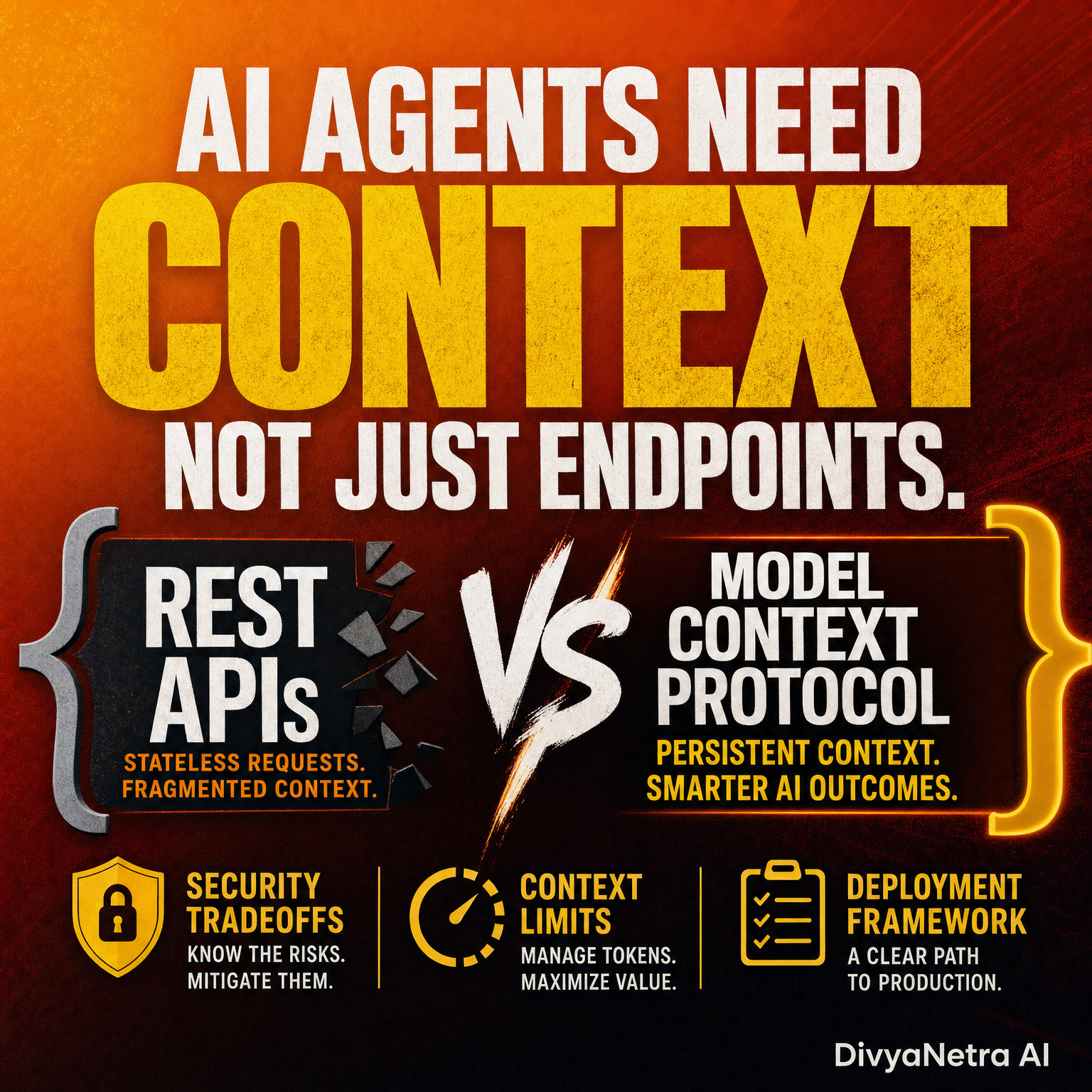
Model Context Protocol vs REST APIs: Enterprise AI Guide
Model Context Protocol vs REST APIs: Connecting Enterprise AI to Data
Introduction
Enterprise AI architectures are undergoing a fundamental shift from static request-response integration to autonomous agentic workflows. For a decade, Representational State Transfer (REST) APIs served as the universal digital plumbing for enterprise software. However, forcing Large Language Models (LLMs) to interact with complex systems through raw REST endpoints creates friction, bloated prompt windows, and fragile translation layers.
To solve this challenge, Anthropic introduced the Model Context Protocol (MCP), an open architecture designed specifically for AI-native context exchange and tool discovery. Rather than requiring engineers to manually build custom endpoint wrappers for every model invocation, MCP provides a standardized interface for connecting natural language intent to enterprise data repositories.
Choosing the right integration layer determines whether your AI deployments scale securely or collapse under architectural debt. At DivyaNetra AI, we evaluate integration frameworks based on system complexity, latency requirements, and governance controls. This guide outlines the core tradeoffs between MCP and REST APIs to provide your engineering team with a definitive decision path.
Architectural Differences: Model Context Protocol vs REST APIs
The fundamental contrast between REST APIs and MCP lies in their core intent. REST APIs were built for machine-to-machine communication with deterministic parameters, fixed endpoints, and static data schemas. Every interaction requires the client to know the exact endpoint URL, request payload structure, and authentication header upfront.
Conversely, MCP functions as an open standard that abstracts interface discovery for AI hosts, clients, and servers. As detailed in Anthropic’s release Introducing the Model Context Protocol, MCP creates a standardized two-way protocol where LLMs can dynamically discover available prompts, context resources, and execution tools at runtime.
Instead of forcing the LLM to process heavy OpenAPI specifications inside its context window, MCP uses standardized JSON-RPC 2.0 messages over standard I/O or HTTP with Server-Sent Events (SSE). This client-server model allows enterprise applications (hosts) to connect seamlessly to multiple local or remote data servers without custom integration code for every downstream system.
Performance and Security Tradeoffs in Enterprise AI Integration
Integrating enterprise data into agent workflows introduces distinct security and maintenance tradeoffs across both paradigms. Traditional REST architectures require building intermediate middleware that maps model tool calls directly to REST endpoints. While this approach offers strict endpoint-level control, it rapidly degenerates into an $N \times M$ integration problem as you scale models and tools.
From a governance perspective, REST APIs rely on established OAuth, API tokens, and role-based access control (RBAC). However, when AI agents dynamically chain REST calls together, tracking granular authorization becomes difficult. As research shows, 67% of enterprise AI agents lack basic permission controls when directly integrated into raw legacy APIs without intermediate authorization guards.
MCP solves this by introducing standardized resource boundaries and user consent primitives directly into the context transport layer. According to a technical MCP vs. REST analysis by WorkOS, MCP shifts integration from point-to-point endpoint mapping to context-aware discovery. However, because MCP maintains active state connections and dynamic schema discovery, it adds minor overhead compared to hyper-optimized, single-purpose REST calls. Organizations evaluating these choices must balance raw throughput against the overhead of managing dynamic decision chains, a key pillar of effective data governance vs decision governance.
Enterprise Decision Framework: Selecting MCP vs REST APIs
Engineers often fall into the trap of viewing MCP and REST as mutually exclusive options. In practice, MCP servers frequently wrap existing enterprise REST APIs to make them accessible to AI agents. However, when deciding where to build direct software interfaces versus standardized protocol servers, follow this clear, non-ambiguous framework:
Build Direct REST APIs When:
- High-Throughput Deterministic Pipelines: Your systems handle high-volume data streams (e.g., streaming telemetry, order processing) where natural language intent or dynamic reasoning adds unnecessary overhead.
- Point-to-Point Microservice Communication: Service-to-service internal communication requires strict, compile-time type safety and static contracts without LLM involvement.
- Existing Client SDK Infrastructures: Legacy web applications and mobile clients already consume mature API gateways with strict SLA guarantees.
Implement Model Context Protocol (MCP) When:
- Multi-System Agentic Retrieval: Your AI agents must dynamically explore and retrieve data across multiple disconnected platforms (e.g., Salesforce, Jira, and internal SQL databases) during a single conversation.
- Dynamic Tool Selection at Scale: You manage dozens of enterprise actions and need models to discover relevant tools dynamically without flooding the context window with static OpenAPI specs.
- Standardizing Multi-Model Infrastructure: You want to avoid rewriting custom integration code whenever switching underlying model providers or updating client-facing LLM hosts.
Conclusion
The debate between Model Context Protocol vs REST APIs is not about replacing existing infrastructure, but about choosing the right integration paradigm for the cognitive layer of your software stack. REST APIs remain the indisputable standard for high-throughput, deterministic microservice integration. However, attempting to build autonomous AI workflows purely on raw REST wrappers creates fragile systems that scale poorly.
For modern enterprise deployments, MCP represents the future of AI-to-data connectivity. By standardizing context retrieval, tool invocation, and resource management into an open protocol, MCP allows enterprises to decouple model logic from underlying data architectures.
At DivyaNetra AI, we advise enterprise teams to establish a hybrid architecture: retain robust REST APIs at the data layer, but wrap them with standardized MCP servers to power secure, context-aware AI execution. Adopting this clear boundary today protects your infrastructure against model lock-in while ensuring your AI agents operate with governance, security, and precision.