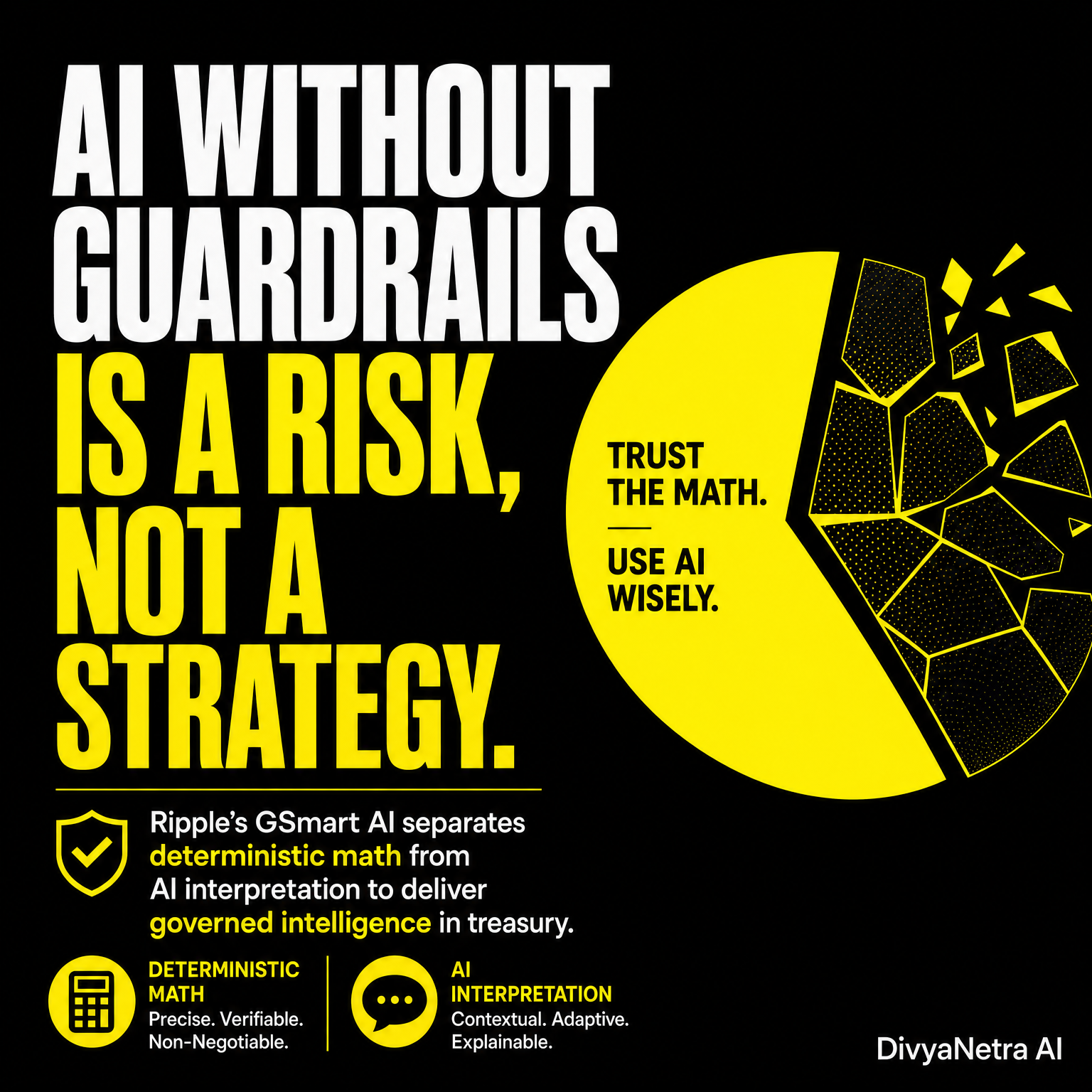
Ripple GSmart AI: Why Financial Risk Needs Deterministic Math
Ripple's GSmart AI: Why Financial Risk Needs Deterministic Math
Introduction
On September 10, 2026, Ripple Treasury announced a critical breakthrough in enterprise financial technology: the launch of governed AI capabilities within its GSmart platform. According to details released in Ripple Treasury Brings Industry's First Governed AI for Enterprise Treasury, the new framework explicitly decouples deterministic mathematical calculations from probabilistic generative AI interpretation.
This distinction addresses a systemic vulnerability in enterprise finance. As corporations rush to deploy autonomous agents for cash positioning, yield optimization, and foreign exchange (FX) hedging, standard generative models present inherent operational risks. Large language models (LLMs) predict statistical text patterns; they do not compute immutable arithmetic truth.
For enterprise CFOs and risk managers, relying on an unconstrained neural network to calculate balance sheets or execute interest rate swaps is an unacceptable risk. Ripple's GSmart AI update establishes a necessary industry benchmark: financial risk management demands deterministic precision at the calculation layer, paired with generative intelligence at the narrative layer.
The Architectural Shift: Why Deterministic Math Belongs Outside LLMs
Large language models excel at processing unstructured natural language, contextualizing market news, and parsing complex treasury policy documents. However, because LLMs generate text based on statistical likelihood rather than algorithmic rules, they remain susceptible to arithmetic errors, floating-point hallucinations, and unpredictable logic variations.
In high-stakes corporate treasury, a rounding error or misplaced decimal point across multi-currency cash flows can cascade into compliance failures or massive monetary losses.
+-----------------------------------------------------------------------+
|                       GOVERNED TREASURY SYSTEM                        |
|                                                                       |
|  +------------------------+             +--------------------------+  |
|  |  Generative AI Layer   |             | Deterministic Math Engine|  |
|  | (Context & Summaries)  |             |  (Audited Code/APIs)     |  |
|  +-----------+------------+             +------------+-------------+  |
|              |                                       |                |
|              +-------------------+-------------------+                |
|                                  |                                    |
|                                  v                                    |
|                   +------------------------------+                    |
|                   | Governed Treasury Decision   |                    |
|                   +------------------------------+                    |
+-----------------------------------------------------------------------+
To deploy governed AI in treasury successfully, modern architectures must decouple computation from translation:
- The Calculation Engine: Must remain strictly deterministic, utilizing audited C++, Python, or WebAssembly routines executing rigid banking logic.
- The AI Agent Layer: Translates natural language requests into structured tool parameters, calls verified API methods, and translates the calculated output into actionable strategic insights.
This architectural isolation solves a pressing security vulnerability. Enterprise benchmarks reveal that 67% of Enterprise AI Agents Lack Basic Permission Controls, leaving financial systems exposed when generative models execute unverified functions. Isolating math from reasoning ensures systemic stability.
How Ripple's GSmart AI Separates Math from Interpretation
The strategic implementation within Ripple's GSmart platform tackles the governance gap directly. As analyzed by industry reports on how Ripple Treasury closes the gap on ungoverned AI agents, GSmart acts as an orchestrated bridge between generative natural language interfaces and secure treasury transaction ledgers.
When a treasury analyst prompts GSmart to evaluate foreign exchange exposure across international subsidiaries, the system does not allow the underlying LLM to guess net currency valuations. Instead, GSmart executes a structured, multi-step pipeline:
- Query Parsing: The generative AI identifies the user's intent, active entities, timeframes, and target currencies.
- Deterministic Tool Execution: The agent invokes deterministic financial logic engines that compute exact cash positions using precise real-time ledger data.
- Guardrail Validation: System policies verify authorization limits, currency transaction guardrails, and compliance parameters.
- Contextual Synthesis: The calculated results return to the generative engine, which drafts executive summaries, scenario analyses, and yield recommendations.
This pattern exemplifies real-world Human-in-the-Loop AI Governance: Safety in High-Stakes Ops. Treasurers gain the speed of conversational AI without surrendering strict mathematical verification or executive oversight.
5 Key Strategies for Implementing Governed AI in Treasury
Building safe, enterprise-grade financial AI systems requires structured operational controls. Security leaders should adopt these five tactical strategies:
- Mandate Function Calling for Arithmetic: Never permit an LLM to evaluate math formulas directly in-prompt. Always force the model to invoke external, audited calculation tools.
- Implement Hard API Boundaries: Restrict AI agents from directly touching production banking APIs. Route agent actions through permission-gated middleware gateways.
- Utilize Mixed-Model Routing: Direct simple query classification to low-overhead models while routing complex risk calculations through specialized, gated tools. Learn more about optimizing model routing in our guide on Mixed-Model Routing: How to Cut LLM Failures in Code.
- Maintain Immutable Audit Logs: Record every prompt, JSON tool invocation parameter, mathematical response, and user approval in an append-only audit trail.
- Require Explicit Approval Protocols: Mandate mandatory human authorization for any AI-recommended fund transfer, liquidity reallocation, or hedging trade above predefined financial thresholds.
Conclusion
Ripple's launch of governed AI in GSmart marks a critical evolution in corporate finance. By explicitly separating deterministic mathematical tools from probabilistic generative AI interpretation, Ripple has established a scalable operational blueprint for high-stakes enterprise applications.
Relying on ungoverned, purely probabilistic models in treasury operations is an organizational liability. Establishing governed AI in treasury through isolated calculation backends, strict permission boundaries, and rigorous human oversight enables enterprises to capture the full benefits of artificial intelligence while maintaining zero-tolerance financial accuracy.
At DivyaNetra AI, we build and advocate for resilient enterprise AI architectures that prioritize safety, compliance, and deterministic reliability. Enterprise leaders must design their AI agent ecosystems around verified mathematical truth to safeguard critical assets in an increasingly autonomous financial world.