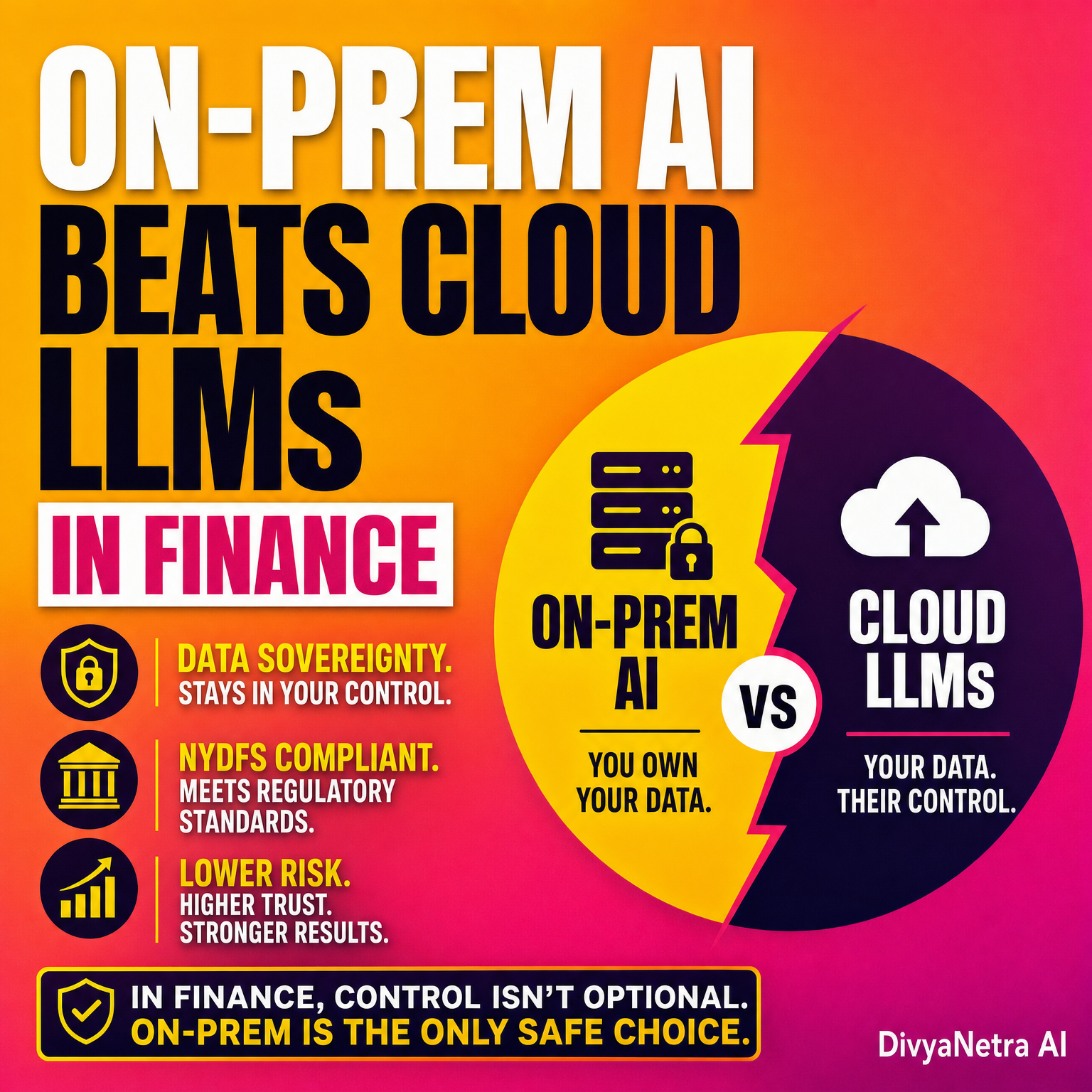
Sovereign AI vs Cloud LLMs: Why On-Prem Rules Finance
Sovereign AI vs Cloud LLMs: Why On-Prem Rules Finance
Introduction
The debate over enterprise AI deployment architecture is reaching a breaking point in institutional finance. While multi-tenant public cloud LLMs offer instant scalability and low barrier-to-entry, high-stakes banking environments demand absolute control over proprietary data, customer privacy, and model execution.
This structural shift was validated by Synapse Analytics securing $13 million in Series A funding to expand its sovereign financial decision engines across emerging markets. Concurrently, strict regulatory guidelines—such as New York Department of Financial Services (NYDFS) cybersecurity mandates—are penalizing financial institutions that offload non-public personal data to third-party API providers.
Financial engineering teams must choose between public cloud convenience and sovereign infrastructure security. This article provides a definitive, clear-cut framework to help engineering leaders evaluate Sovereign AI vs Cloud LLMs for mission-critical financial operations.
Sovereign AI in Finance: Regulatory Mandates and Data Control
Understanding what is Sovereign AI requires recognizing that enterprise data sovereignty goes beyond simple encryption at rest. In financial services, true sovereignty means maintaining physical and logical boundary control over training datasets, model weights, and inference hardware.
Regulatory bodies globally are removing ambiguity around third-party data transmission. NYDFS guidance mandates that financial institutions limit third-party data exposure and maintain full auditing capabilities over automated decision engines. Sending unmasked credit applications or transaction histories to public API endpoints often constitutes a regulatory violation.
Beyond regulatory pressure, financial risk models demand deterministic reliability. As explored in our analysis of Ripple GSmart AI: Why Financial Risk Needs Deterministic Math, credit scoring and fraud detection systems cannot tolerate non-deterministic cloud API output drift or undocumented model updates pushed by vendor platforms.
Furthermore, public cloud models create critical security vectors. Recent industry audits reveal that 67% of Enterprise AI Agents Lack Basic Permission Controls, leaving cloud-hosted agentic pipelines vulnerable to prompt injection, data exfiltration, and unauthorized lateral movement across multi-tenant environments.
Comparing Architectural Trade-Offs: Cloud Scale vs On-Premise AI Deployments
Evaluating on-premise AI deployments against cloud services involves evaluating three major operational dimensions: infrastructure costs, latency, and data governance.
+------------------------+---------------------------------+---------------------------------+
| Dimension              | Public Cloud LLMs               | Sovereign On-Premise AI         |
+------------------------+---------------------------------+---------------------------------+
| Data Governance        | Multi-tenant; third-party risks | Absolute hardware & data isolation |
| Latency & Throughput   | Network-dependent; API throttling| Sub-millisecond direct VPC/bare-metal |
| Long-term Economics    | Variable token-based metering   | Fixed CAPEX; lower unit costs at scale |
| Auditability           | Black-box third-party updates   | Full control of weights & logs  |
+------------------------+---------------------------------+---------------------------------+
Major financial hubs are actively shifting toward enterprise-owned infrastructure. The sovereign financial infrastructure landscape demonstrates that localized GPU clusters running domain-tuned 8B-to-70B parameter models routinely match or exceed generic cloud APIs in financial extraction, contract parsing, and underwriting workflows.
Operational Trade-Offs
- Data Privacy: Cloud LLMs require data anonymization pipelines that add compute latency. On-premise deployments allow direct raw processing of sensitive PII within enterprise air-gapped zones.
- Cost Scaling: At low volume (<50,000 requests per day), cloud APIs are cheaper. At institutional scale (>1,000,000 daily evaluations), token billing far exceeds bare-metal GPU depreciation costs.
- Latency Control: Cloud API response times vary based on global network traffic. Local deployments deliver predictable, ultra-low latency critical for automated algorithmic clearing and high-frequency risk management.
A Definitive Decision Framework for Sovereign Financial AI
Stop defaulting to a vague "it depends" strategy. Use this concrete decision matrix to determine your AI deployment model immediately:
- Deploy Public Cloud LLMs ONLY IF:
- Your application processes purely public data (e.g., scraping open market news, marketing copy generation).
- Total daily query volume is below 20,000 requests, making dedicated GPU infrastructure cost-prohibitive.
-
You are running low-stakes internal pilots where data leakage carries zero regulatory penalty.
-
Deploy Sovereign On-Premise AI IF:
- Your pipeline handles personally identifiable information (PII), credit histories, or proprietary trading algorithms governed by NYDFS, GDPR, or HIPAA rules.
- Inference throughput exceeds 200,000 daily queries, where local hardware investment pays off within 12 months.
- Your systems require strict compliance auditing, zero third-party telemetry, and total ownership over custom-tuned weights.
For institutions managing regulated user data, sovereign on-premise infrastructure is the only viable long-term path for enterprise AI operations.
Frequently Asked Questions
What is the difference between Sovereign AI and standard cloud LLMs?
Sovereign AI guarantees that all data, model weights, and compute infrastructure remain fully under local, physical, or organizational control. Standard cloud LLMs process prompts on shared multi-tenant public infrastructure, exposing financial institutions to external data off-boarding risks.
Why are financial regulators mandating on-premise AI options?
Regulatory bodies like the NYDFS require strict controls over non-public personal information (NPI). Sending customer financial transactions to third-party public LLM APIs risks non-compliance, unauthorized data leakage, and third-party vendor compromise.
Are on-premise AI deployments significantly more expensive than cloud APIs?
While initial capital expenditure for local GPU clusters is higher, high-throughput financial workloads yield lower long-term TCO on-premise compared to token-based public API billing at scale.
Can on-premise Sovereign AI match the intelligence of public cloud models?
Yes. Fine-tuned domain-specific open weights combined with enterprise retrieval-augmented generation (RAG) regularly outperform generalized public cloud LLMs on specialized financial scoring and risk evaluation tasks.
Conclusion
The debate between cloud convenience and operational control in financial technology has reached a definitive conclusion. Regulatory pressure from entities like the NYDFS, combined with market investments in sovereign decision engines, confirms that high-stakes banking environments cannot rely on public, multi-tenant cloud APIs for sensitive operations.
Choosing Sovereign AI vs Cloud LLMs comes down to risk tolerance and infrastructure ownership. While cloud APIs remain useful for non-sensitive, low-volume prototypes, sovereign on-premise deployments are mandatory for enterprise financial decision engines handling sensitive transaction data.
By taking control of your AI stack, your organization secures its proprietary IP, guarantees regulatory compliance, and builds an adaptable foundation for high-performance financial intelligence.